Related Is Not Identical: Framework and Control Mapping Without the Spreadsheet Monster
Browse all 27 field guides
- Alert to Conclusion: Investigating Without Tunnel Vision
- From Header to Host: Investigating Phishing in the SOC
- How to Think Like a SOC Analyst in an Interview
- Identity Attacks for SOC Analysts: Sessions, Tokens, MFA and Account Compromise
- The IP Isn't the Attacker: A SOC Analyst's Guide to NAT, VPNs and Proxies
- PowerShell Is Not the Alert: Investigating Living-off-the-Land Activity
- Ransomware Before the Ransomware: What the SOC Should See Before Encryption Starts
- SPF, DKIM and DMARC: What They Actually Prove (and What They Don't)
- Threat Hunting for SOC Analysts: Turning a Suspicion Into a Searchable Hypothesis
- Windows Event Logs for SOC Analysts: What an Event ID Actually Proves
- One Alert Is Not the Incident: Scoping Security Incidents in the SOC
- Beyond the Alert: CIS Critical Security Controls v8.1 for SOC Analysts
- Six Functions, Not Six Steps: NIST CSF 2.0 for SOC Analysts
- Check the Scope First: ISO 27001 for SOC Analysts
- Search It, Don't Memorise It: NZISM for Security Practitioners
- Same Problem, Four Lenses: CIS vs NIST vs ISO 27001 vs NZISM
- A Claim Is Not Evidence: Security Assurance for SOC Analysts
- Inherent Risk Comes First: Supplier Security Assurance for Analysts
- Present Is Not Effective: How to Test Security Controls
- A Clean Opinion Is Not Zero Risk: How to Read a SOC 2 Report
- Count Is Not Risk: Security Metrics, KPIs and KRIs That Actually Matter
- Read the Scope Before the Findings: How to Review a Penetration Test Report
- Not the Assessment Itself: How to Design a Supplier Security Questionnaire
- Which Part? Cloud and SaaS Security Assurance
- Lead With the Decision: Executive Security Risk Reporting
- Related Is Not Identical: Framework and Control Mapping Without the Spreadsheet Monster (this article)
- CIS, NIST, ISO 27001 and NZISM: The Interview Guide for Security Practitioners
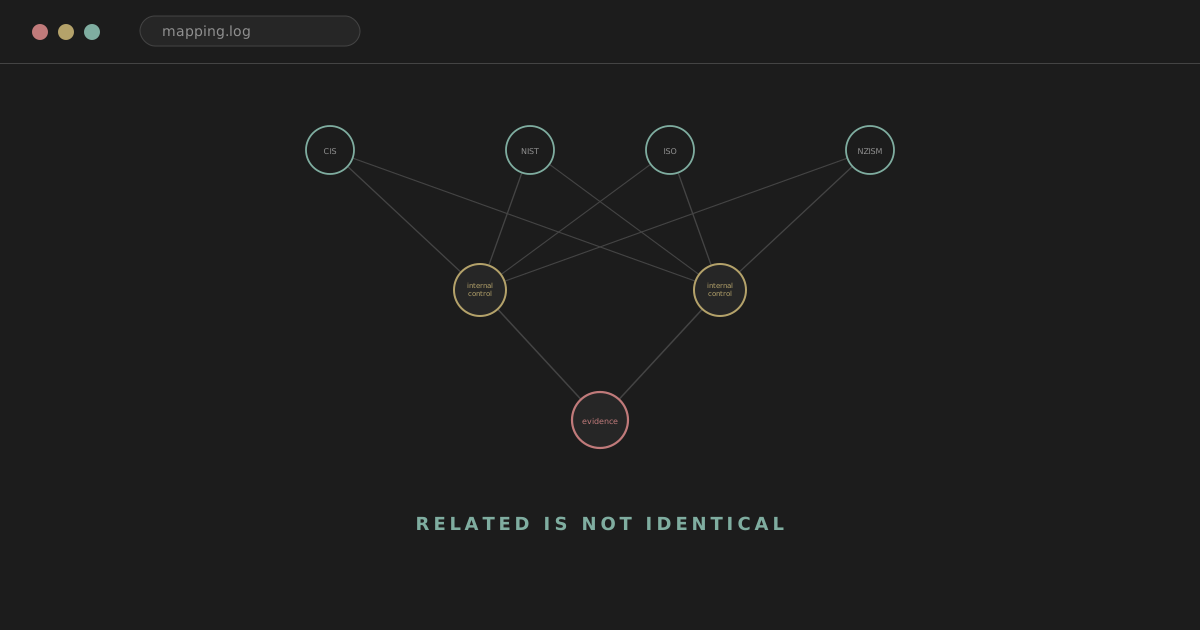
A mid-sized organisation runs CIS, NIST CSF, ISO 27001 and NZISM at once, plus an internal security policy layered on top. Somewhere along the way, a well-meaning attempt to track all of it produced a spreadsheet: 1,200 rows. Scroll through it and the same idea keeps reappearing in different clothes. "Use MFA." "Protect privileged accounts." "Restrict administrative access." "Review access periodically." "Authenticate users appropriately." Five teams get asked, separately, for screenshots that would answer essentially the same question four or five times over. Nobody enjoys the process, and nobody's entirely sure the spreadsheet is actually making anything safer.
Ask the obvious question. Does this organisation genuinely have 1,200 distinct security controls? Almost certainly not. It probably has a much smaller number of things it actually does, mapped against a much larger number of things different frameworks happen to ask for. That gap, between what you actually do and how many different ways external requirements describe it, is where control mapping earns its keep.
Remember this
Mapping identifies relationships. Mapping does not make different requirements identical. A control that relates to four framework requirements still needs to be checked against each one's actual scope, wording and evidence expectations, not assumed to satisfy all four just because a spreadsheet cell says so.
This article assumes you already understand what CIS, NIST CSF, ISO 27001 and NZISM are each for, covered in depth in the framework series, and what assurance, evidence and findings actually mean, covered in Security Assurance and Security Control Testing. This one is specifically about the layer that sits between "we have four different sets of requirements" and "we have one thing we actually do that reasonably addresses all of them."
analyst@thefish.nz:~$ cat contents.txt
Sections
- What is framework mapping?
- Mapping is not equivalence
- Why one-to-one mapping usually fails
- One-to-many and many-to-one
- Start with the objective
- Building a control library
- Requirement to evidence chain
- The mapping questions
- Mapping strength
- Framework mapping vs control mapping
- Worked examples
- Mapping and ISO 27001
- Mapping and NIST CSF
What is framework mapping?
Framework mapping identifies relationships between requirements, outcomes or controls from different sources. A CIS safeguard about privileged access relates to a NIST identity outcome, which relates to relevant ISO 27001 risk and control material, which relates to an applicable NZISM requirement. Mapping is the practice of answering: where are these different requirements actually pointing at the same underlying security concern?
That's a genuinely useful question. It's also, on its own, an incomplete one, because "pointing at the same concern" and "asking for the same thing" are not the same claim, and the rest of this article is largely about that gap.
Mapping is not equivalence
This is the strongest idea in the whole article, worth stating plainly before anything else. If a CIS safeguard maps to a NIST subcategory, that does not mean the two are identical. The relationship could be a partial overlap, the same underlying intent applied at different scope, one requirement considerably broader than the other, one considerably more prescriptive, or a case where satisfying one genuinely needs several separate controls rather than one.
A mapping is a claim about relatedness, not a claim about sameness. Implementing the CIS safeguard does not automatically mean the NIST outcome is achieved, the ISO control is evidenced, or the NZISM requirement is satisfied. Each one still needs its own scope, wording and evidence checked on its own terms. Losing sight of that single distinction is how a mapping table quietly turns into a false compliance conclusion, "we mapped it, so we're covered," without anyone having actually verified anything.
Why one-to-one mapping usually fails
Part of the reason forced one-to-one mapping breaks down is structural: these four frameworks aren't built the same way, and expecting a clean one-line correspondence between them ignores that.
CIS is built around concrete, practical safeguards, specific and actionable, with Implementation Groups attached. NIST CSF is outcome-oriented: it describes what an organisation should be achieving, largely without prescribing exactly how. ISO 27001 combines management-system requirements, context, leadership, risk assessment and treatment, internal audit, management review, continual improvement, with a set of reference controls selected against assessed risk. NZISM is detailed and government-specific, with its own MUST/SHOULD compliance language, classification-awareness, and a formal certification, accreditation and dispensation process wrapped around individual requirements.
Trying to force one CIS safeguard to equal one NIST subcategory to equal one ISO control to equal one NZISM requirement will usually be inaccurate somewhere in that chain, because the four documents simply aren't answering the same kind of question at the same level of granularity. The comparison article covers this same structural difference from the "which should I learn" angle; this article picks it up from the "how do these actually relate to each other" angle instead.
One-to-many and many-to-one
Two shapes turn up constantly once you actually start mapping, and it's worth having names for both.
One-to-many. A single organisational objective, protect privileged access, can require several distinct controls underneath it: MFA, separate administrative identities, a privileged-access management capability, periodic access review, just-in-time privilege, and account lifecycle management. One framework requirement can genuinely need several operational controls to actually satisfy it.
Many-to-one. Conversely, several separate framework requirements can be partly satisfied by one well-designed internal control. "All privileged access requires named individual identities and MFA, with access reviewed quarterly" might contribute toward identity requirements, privileged-access requirements, authentication requirements and review requirements all at once, across multiple frameworks. Useful, provided each of those source requirements actually gets inspected individually rather than assumed satisfied because the general shape looks right.
FRAMEWORK REQUIREMENTS
 A   B   C   D   E
  \  |  / \  |  /
   \ | /   \ | /
  CONTROL 1  CONTROL 2
      \        /
       \      /
        EVIDENCE
Simplified, illustrative shape, not a claim about any specific real mapping.
Start with the objective, not the control number
A common failure mode: start from a framework's control numbers and try to build outward from them. A more durable approach starts from the actual security outcome the organisation is trying to achieve, and only afterwards asks which framework requirements relate to it.
Control objective, stated first: only authorised individuals should receive privileged access, and privileged actions should be attributable to a named identity. That sentence doesn't reference CIS, NIST, ISO or NZISM at all, and that's deliberate. Define the objective. Define the control that achieves it. Then, and only then, map the relevant frameworks onto it. Reversing that order, starting from control numbers and trying to reverse-engineer an objective from them, tends to produce exactly the disconnected, spreadsheet-first thinking this whole article is arguing against.
Building a control library
Instead of separate control sets per framework, build one internal control library that becomes the organisation's actual common layer. A reasonable set of fields: control ID, control objective, control description, owner, scope, implementation, evidence, test procedure, frequency, exceptions, and mapped requirements.
A worked example, entirely fictional: IAM-PRIV-01. Objective: privileged administrative access is restricted to authorised individuals, and privileged actions can be attributed to a named identity. Implementation: named administrator accounts, MFA required for privileged sessions, just-in-time privilege activation, quarterly access review, and centralised logging of privileged activity. Evidence: a privileged-account inventory, MFA configuration records, activation logs from the privilege-management platform, access-review sign-off records, and authentication logs. Test: define the population of privileged identities, verify MFA enforcement, sample a set of privilege activations, verify the review actually occurred and was acted on, and inspect any recorded exceptions.
Several framework requirements might relate to IAM-PRIV-01 conceptually: CIS material on account and access-control management, NIST identity and access-control outcomes, ISO access-control-related risk and control material, and NZISM authentication and access requirements where applicable. Deliberately no exact control identifiers here; where a mapping needs a specific safeguard number, subcategory code, control reference or NZISM section, that needs checking against the live, current, authoritative source at the time the mapping is built, not copied from an old article, this one included.
Notice what doesn't transfer
Even a well-designed control like IAM-PRIV-01 won't fully cover everything a stricter requirement demands. NZISM, in a relevant government context, may attach additional applicability and classification conditions that a generic internal control simply doesn't address on its own. That gap is exactly the kind of thing mapping should surface, not quietly absorb.
Requirement to evidence chain
A useful model for tracing any individual mapping all the way through:
Source requirement
↓
Organisational control
↓
Implementation
↓
Evidence
↓
Test
↓
Result
Multiple source requirements can converge on the same organisational control partway down this chain, that's the many-to-one shape from earlier, but each one still needs its own honest answer at the result stage. "Satisfied," "partially satisfied," or "not satisfied for this specific requirement" are all legitimate outcomes even when they're sitting on top of exactly the same control and the exact same evidence.
The mapping questions
For any proposed mapping, three questions do most of the actual work.
1. Do they address the same security objective? Not whether the wording looks similar, whether the underlying intent genuinely matches.
2. Do they apply to the same scope? Same systems, same population, same environment, same applicability conditions.
3. Would the same evidence reasonably support both? If the honest answer is no, the mapping is at best partial.
If all three hold up under real scrutiny, the mapping is likely strong. If one or more doesn't, it's partial, and that should be recorded as partial rather than quietly rounded up to a full match because the spreadsheet wants one value in the cell.
A fourth question is worth adding on top of the standard three, because it catches something the first three can miss: what does the second requirement contain that the first one doesn't? Two requirements can both genuinely relate to logging, and one can still carry a specific applicability or classification condition, a specific retention period, a specific notification obligation, that a generic internal logging control simply doesn't cover. Asking what's unique to each side is how mapping avoids quietly losing a real requirement inside an apparently comfortable match.
Mapping strength
It can help to record how strong a given relationship actually is, rather than treating every mapping as equally solid. A simple, illustrative version, not an industry standard:
| Strength | Meaning |
|---|---|
| Direct | The internal control strongly addresses the source requirement |
| Partial | The internal control addresses part of the requirement |
| Supporting | The control contributes, but isn't sufficient alone |
| Not applicable | No genuine relationship for this scope |
For a genuinely rigorous, published methodology, NIST's IR 8477 defines a formal set-theory approach for exactly this problem, used for the official mappings NIST itself publishes through its Online Informative References programme: relationships like Subset Of, Intersects With, Equal, Superset Of and No Relationship. Even NIST's own formal approach lands on the same underlying point this article is making: most cross-framework relationships aren't simple equality, they're partial overlaps of varying shape, and that shape is worth recording explicitly rather than flattening into a single "mapped, yes or no" checkbox.
Framework mapping vs control mapping
Worth being explicit about a distinction that's easy to blur. Framework-to-framework mapping relates one external framework's requirements directly to another's, a NIST outcome to a CIS safeguard, for instance. Control mapping relates an organisation's own internal controls to external requirements from multiple frameworks at once.
The second is usually more operationally useful, because the question an organisation actually needs answered day to day isn't "how does NIST relate to ISO in the abstract," it's "what do we actually do, and which of our own requirements does that satisfy." Framework-to-framework mapping is a useful study aid and a useful starting reference. Control mapping is what you actually run an assurance programme on.
This also explains why internal control mapping tends to age better. If NIST releases a new version, CSF 1.1 moving to CSF 2.0 is the clearest recent example, an organisation with a solid internal control library updates the mappings, not the underlying controls themselves. IAM-PRIV-01 doesn't change. What changes is which current NIST reference it points at. An internal control named directly after an external framework's own numbering, something like a control literally called "NIST PR.AA-XX," breaks the moment that numbering changes; a control named for what it actually does, IAM-PRIV-01, doesn't. This is a genuinely practical reason to prefer readable, framework-independent internal IDs, IAM-01, LOG-02, VULN-03, SUP-04, IR-01, over anything borrowed directly from an external framework's own numbering scheme. No single naming convention is mandatory here, the point is decoupling operational identity from something you don't control the stability of.
Worked examples
MFA. Organisational control: privileged interactive access requires appropriately strong MFA. Conceptually this relates to CIS access-control and account-management material, NIST identity and authentication outcomes, ISO's authentication-related risk and control content, and NZISM's applicable authentication requirements. No exact safeguard numbers, subcategory codes or NZISM section references here deliberately; verify any specific identifier against the current live source, not against a secondary summary, this article included.
Logging. A single generic "we have logging" control rarely satisfies everything different frameworks care about. Break it apart: systems generate appropriate security events; logs are centrally collected; monitoring health is checked; logs are protected and retained; events are actually reviewed. Different requirements tend to care about different pieces of that chain, which is why this tends to be one-to-many rather than a flat mapping.
Vulnerability management. Rather than one control called "we run scans," a small set works better: asset scanning coverage, risk-based prioritisation, remediation targets, exception handling, remediation validation. Reducing a vulnerability-management programme to "we run Nessus" is exactly the collapse that makes mapping meaningless; a scanning tool is one piece of evidence supporting one part of one control, not the whole objective.
Mapping and ISO 27001
Particular care is warranted here. ISO 27001 combines management-system requirements, context, leadership, planning, support, operation, performance evaluation, improvement, with Annex A reference controls selected through risk treatment. A significant part of the standard concerns things like internal audit, management review and continual improvement, which simply don't map neatly onto CIS's practical technical safeguards at all. Mapping everything in ISO 27001 straight to Annex A, and ignoring the management-system requirements that sit around it, misrepresents a meaningful part of what certification actually assesses.
Watch out
Be careful reproducing ISO material directly. Don't copy full ISO clauses, Annex A control descriptions, or any paid crosswalk document into an internal mapping table. Reference the relevant control or clause number, paraphrase the intent at a high level in your own words, and link to the standard itself rather than transcribing its protected text.
Mapping and NIST CSF
NIST CSF 2.0 is outcome-oriented, and a single subcategory can genuinely require several distinct controls to actually achieve. NIST itself maintains official Informative References, including a published mapping between CSF 2.0 and ISO/IEC 27001:2022, through its Online Informative References programme, built using the IR 8477 methodology referenced above. Where NIST-to-ISO alignment specifically matters to your mapping work, that official NIST resource is a considerably stronger starting point than an unverified secondary spreadsheet, and it's worth reading directly rather than assuming any particular relationship from memory.
Mapping and CIS
CIS is the most concrete of the four, which makes it a genuinely useful anchor for mapping practical safeguards into broader outcome language. CIS itself publishes an official mapping between CIS Controls v8.1 and NIST CSF 2.0, released alongside v8.1 specifically to keep the two aligned, CIS added the Govern function to v8.1 partly for this reason. CIS also offers mapping material connecting its Controls to other frameworks including ISO 27001, though worth distinguishing: material CIS describes as community-developed carries a different level of authority than CIS's own first-party NIST CSF mapping, and it's worth checking which category a given CIS mapping document actually falls into before leaning on it heavily. Even within CIS itself, remember that a Safeguard's applicability can vary by Implementation Group, so a mapping built entirely around IG1 may not represent an organisation actually operating at IG2 or IG3.
Mapping and NZISM
NZISM deserves particular caution, for the same reason the comparison article flags directly: it's the framework with the most detailed, most mandatory, and most context-dependent requirements of the four. Mapping a generic internal control to an NZISM section does not, on its own, prove current NZISM compliance. Preserve exactly what NZISM adds on top of a generic mapping: compliance level (MUST versus SHOULD), classification and applicability conditions, any formal exception or dispensation already in place, and the government-specific governance, certification and accreditation process wrapped around the requirement.
I could not find an official, GCSB or NCSC-published crosswalk mapping NZISM requirements directly onto CIS, NIST or ISO 27001 equivalents. If one exists that this research didn't surface, it's worth checking the live NZISM directly before relying on any third-party version. In its apparent absence, treat any NZISM-to-other-framework mapping as illustrative only, exactly the same caution the NZISM article and the comparison article both raise from their own angles: an ISO 27001 certificate does not prove NZISM compliance, and neither does a tidy-looking mapping row.
Gap analysis
Once a mapping actually exists, it becomes genuinely useful for something beyond satisfying a spreadsheet: finding requirements that don't have an adequate internal control behind them yet.
SOURCE REQUIREMENTS
        ↓
MAP TO INTERNAL CONTROLS
        ↓
UNMAPPED OR PARTIAL
        ↓
ASSESS APPLICABILITY
        ↓
GAP?
        ↓
TREATMENT
The step easiest to skip, and the one most worth protecting, is applicability. An unmapped requirement is not automatically a gap; it might simply not apply to this organisation, this system, or this scope at all. This matters especially for NZISM (not every requirement applies to every system or classification), ISO's Statement of Applicability concept (which explicitly records inclusions, exclusions and justifications), and contractual or sector-specific requirements that may only apply to part of the environment. Confirm applicability before declaring a gap; treating every unmapped row as an automatic finding produces exactly the kind of noisy, low-value assurance output this whole article is trying to help you avoid.
Evidence and test reuse
This is genuinely one of the strongest practical benefits of good control mapping. If IAM-PRIV-01 legitimately relates to several separate requirements, one well-designed evidence set, a privileged-account inventory, MFA configuration, access-review records, authentication logs, can support several separate assessments at once, rather than the control owner being asked for functionally the same screenshots four or five separate times.
The same logic applies to testing: test a control once, and where scope and requirement alignment genuinely support it, that one result can inform multiple mapped requirements. This is where mapping actually reduces the assurance burden this whole article opened by describing.
But reuse has a real limit, and it's worth stating directly. An MFA test performed only against Microsoft 365 administrators does not prove MFA is enforced for AWS administrators, network-device administrators, or legacy applications. Coverage matters as much as the test result itself; record exactly which systems and populations a piece of evidence actually applies to, so "control tested" never quietly becomes "control tested on one platform, and we're assuming the rest."
The spreadsheet monster
Recognisable signs: 1,500 rows and counting. Duplicate controls with no shared owner. No attached evidence. No defined test procedure. Five separate framework columns nobody can confidently explain. Stale version numbers next to frameworks that have since moved on. Colour-coded cells standing in for actual reasoning. And, most tellingly, nobody in the organisation can state the actual control objective behind any given row without opening three other documents first.
The fix isn't a bigger, smarter spreadsheet. It's fewer, clearer internal controls, each with a genuine objective, owner, evidence and test procedure, connected to source requirements through mappings that are honest about their own strength.
For a smaller organisation, a minimum viable model can be enough: control ID, objective, description, owner, evidence, test, framework mappings, exceptions. Don't build an enterprise data model for a ten-person team; a small, honest control library beats an ambitious one that never gets maintained. A useful starting posture for a smaller NZ organisation specifically: treat CIS as the practical baseline, then layer in customer contractual requirements, ISO aspirations and NZISM only where they genuinely apply, rather than building a full four-framework crosswalk from day one.
A larger organisation, running multiple scopes and regulatory overlays at real scale, will likely outgrow a spreadsheet, not because spreadsheets are inherently wrong, but because the underlying relationship is genuinely many-to-many, and a flat table struggles to represent that cleanly. That's a reasonable, later argument for a relational database or a dedicated GRC tool. It is not, on its own, a reason to buy one before the model and process actually work on a whiteboard first.
A better data model
A flat spreadsheet genuinely struggles with many-to-many relationships: one control mapping to many requirements, and one requirement needing several controls, at the same time. A cleaner conceptual model separates the concerns instead:
CONTROLS  ↔  MAPPINGS  ↔  REQUIREMENTS

CONTROLS  ↔  EVIDENCE

CONTROLS  ↔  TESTS
Controls, requirements, evidence and tests as genuinely separate entities, connected by explicit relationships, rather than one enormous row trying to hold all of it at once. Whether that actually lives in a spreadsheet with several linked tabs, a lightweight database, or a proper GRC platform is a scale decision, not a philosophy decision; the underlying model is what actually matters, and it's worth getting the model right before worrying about which tool eventually hosts it.
Maintaining mappings as frameworks change
Frameworks aren't static, NIST CSF 1.1 became CSF 2.0, CIS moved from v7 to v8 to v8.1, ISO added Amendment 1 in 2024, NZISM issues regular version updates, and a mapping built against an old version quietly becomes wrong the moment the source material moves and nobody revisits it.
Record source version, mapping version, review date, owner and change history for every mapping that matters. A reasonable update workflow:
NEW FRAMEWORK VERSION
        ↓
IDENTIFY CHANGED REQUIREMENTS
        ↓
COMPARE AGAINST EXISTING MAPPINGS
        ↓
ASSESS INTERNAL CONTROL IMPACT
        ↓
UPDATE MAPPINGS
        ↓
GAP ANALYSIS
        ↓
TEST OR REMEDIATE AS NEEDED
Don't rebuild the entire control library from scratch every time a framework updates; identify what actually changed, and update only the mappings genuinely affected by that change. A mapping table copied years ago and never revisited, still referencing retired control numbers or a superseded framework version, isn't a control library any more. It's a liability dressed up as evidence, and maintaining mappings properly is itself part of running an assurance programme, not a one-off setup task you finish once and forget.
AI and control mapping
AI genuinely helps with parts of this work: suggesting semantically related controls, flagging likely duplicate controls sitting in different rows, summarising the difference in wording between two requirements, and surfacing requirements that don't appear to have any internal control mapped to them yet.
What AI must not do is determine compliance on its own. Real risks worth watching for specifically: hallucinated control identifiers that don't actually exist in the current version of a framework, references to an outdated framework version presented as current, superficial semantic matches that share vocabulary without sharing actual intent or scope, missed scope differences that a human reviewer would catch immediately, and copyright problems from reproducing protected framework text directly.
Watch out
Never ask an AI system to "map all NZISM requirements to ISO from memory," or any equivalent request that asks a model to invent a crosswalk rather than work from an actual authoritative source. Provide the real source text or a verified reference, have the AI suggest related internal controls against it, and have a human validate objective, scope and mapping strength before anything gets recorded. A reasonable workflow: provide authoritative source material, let AI suggest candidate internal controls, have a human validate intent and scope, assign a mapping strength, review evidence and test requirements, then store the mapping with its source and version attached. AI accelerates the drafting step. It does not replace the validation step.
Mapping in practice
A well-built control library pays off beyond the mapping exercise itself. In an audit, "how do you satisfy requirement X" gets a clean, traceable answer, requirement X maps to internal control IAM-04, here's the implementation, evidence and latest test result, instead of a scramble through scattered documents. In supplier assurance, a questionnaire question like "describe privileged production access" can map directly to your own privileged-access control objective, the same principle covered from the supplier side in Supplier Security Assurance and Supplier Security Questionnaires: a supplier's control doesn't need to be identical to yours to be relevant, it needs to be mapped honestly against what you actually require.
A supplier's SOC 2 report works the same way: specific tested controls support specific mapped requirements, "clean opinion" is not itself a mapping. A penetration test finding can indicate a weakness in a mapped control without proving every requirement relying on that control has failed; use the finding as test evidence, not an automatic compliance verdict.
Attaching metrics to controls rather than framework line items means every framework mapped to that control shares one operational view, one MFA-coverage metric instead of four slightly different versions of the same number. And when an incident reveals a control failed, mapping helps identify its real governance blast radius, which requirements and contracts actually depended on it, feeding into the scoped, evidence-based reporting covered in Executive Security Risk Reporting, without overstating a narrow failure into "every mapped framework is now non-compliant."
Practical exercises
Exercise 1. Take four simplified, paraphrased MFA-related requirements, one from each framework. Would one internal MFA control genuinely satisfy all four? Identify what's unique to each.
Exercise 2. Take "maintain security logs" and break it into separately testable controls the way this article's logging example does. Map each piece separately rather than as one line.
Exercise 3. NIST releases a new CSF version. What actually needs updating, every downstream technical control, or the mappings pointing at the changed requirements? Justify the answer.
Exercise 4. An internal control performs an annual access review. An external requirement calls for a quarterly privileged-access review. Is this a full mapping or a partial one? What's the actual gap?
Exercise 5. MFA has been tested against Microsoft 365 administrators only. A mapping table claims "privileged access control effective" across the environment. What's wrong with that conclusion?
Exercise 6. You're handed four rows: a CIS safeguard, a NIST subcategory, an ISO control area and an NZISM requirement, all broadly about MFA. Should these become four separate internal controls? Design the single organisational control instead, and record what each source requirement still needs preserved individually.
Exercise 7. A customer contract requires incident notification within a specific timeframe. A generic internal control says "notify customers appropriately." Does that fully map? What specific condition needs its own explicit traceability?
Interview questions
"What is control mapping?" Identifying relationships between requirements, outcomes or controls from different sources, so the organisation can understand where they're pointing at the same underlying security concern. "Why do organisations map frameworks?" To avoid rebuilding the same control repeatedly for each framework, to reuse evidence and testing sensibly, and to see clearly where genuine gaps exist. "Does a mapped control prove compliance?" No, mapping shows a relationship exists; whether the control is actually implemented, tested and effective for that specific requirement is a separate question that still needs answering. "What's a partial mapping?" A relationship that covers part of a requirement's intent or scope but not all of it, and it should be recorded as partial rather than rounded up. "How do you avoid duplicate controls?" Start from the control objective, not from framework control numbers; build one internal control, then map multiple external requirements onto it. "How do you handle one-to-many mappings?" Recognise when a single requirement genuinely needs several distinct operational controls, and build them as separate, individually testable controls rather than one vague catch-all. "What happens when a framework version changes?" Identify the changed requirements, compare them against existing mappings, assess impact on internal controls, and update the mappings, not necessarily the controls themselves. "How would you map NIST outcomes to technical controls?" Start from the outcome's actual intent, identify what technical controls genuinely contribute to achieving it, and record the relationship's strength honestly rather than assuming a single control fully covers it. "How do you use mapping to reuse evidence?" Attach evidence to the internal control rather than to each framework separately, and confirm the evidence's actual scope covers every requirement it's being used to support. "What are the risks of automated or AI-assisted control mapping?" Hallucinated identifiers, outdated framework references, superficial semantic matches that miss real scope differences, and treating AI output as a finished mapping instead of a draft that still needs human validation.
A model answer for "how would you build a control mapping between multiple frameworks": start with authoritative source requirements. Define organisational control objectives. Build genuinely testable internal controls. Map external requirements by intent and scope, not by wording similarity alone. Record direct and partial relationships honestly. Preserve whatever's unique to each source requirement rather than losing it inside a comfortable-looking match. Attach evidence and test procedures to the internal control. Validate applicability before declaring anything a gap. Perform gap analysis on what's genuinely left over. Version the mappings, and review them whenever a source framework changes. Reuse evidence and testing where scope genuinely supports it. And never assume mapping equals compliance.
Common mistakes
"Similar wording means equivalent control." No, read actual intent, scope and evidence expectations, not just the label. "Every framework needs its own controls." No, one well-designed internal control can relate to several. "One control maps to one requirement only." No, many-to-many is the normal shape. "Mapping proves compliance." No, mapping shows a relationship; testing and evidence prove effectiveness. "A spreadsheet with framework columns is a control framework." No, it's a reference document, not a management system. "Control numbers matter more than objectives." No, numbers change between versions; objectives persist. "All mappings should be one-to-one." No, forcing that shape misrepresents how these documents relate. "Partial mappings are a bad result." No, they're often the honest one. "An official crosswalk needs no further validation." No, even NIST's own mappings use a formal methodology precisely because relationships genuinely vary in strength. "AI can generate the mapping and we're done." No, AI accelerates a draft; a human still validates intent, scope and evidence. "ISO Annex A maps cleanly onto CIS." No, ISO's management-system requirements cover considerably more than Annex A alone. "An NZISM mapping means NZISM compliance." No, compliance level, classification and applicability have to be checked individually every time.
The point
Back to that 1,200-row spreadsheet. The actual goal was never to build a perfect crosswalk covering every possible relationship between four different frameworks. It was to understand how the requirements the organisation faces relate to what the organisation actually does, and to stop asking five teams for functionally the same screenshot five separate times.
Each of these frameworks describes broadly the same underlying security expectations in a genuinely different language, practical safeguard, cybersecurity outcome, risk-managed system, formal government requirement. Your control library describes how your organisation actually manages that risk, in its own words, with its own evidence. Good mapping is the discipline of connecting the two honestly, preserving what's genuinely different between them along the way. Bad mapping just adds more rows to a spreadsheet nobody can actually explain.