Lead With the Decision: Executive Security Risk Reporting
Browse all 27 field guides
- Alert to Conclusion: Investigating Without Tunnel Vision
- From Header to Host: Investigating Phishing in the SOC
- How to Think Like a SOC Analyst in an Interview
- Identity Attacks for SOC Analysts: Sessions, Tokens, MFA and Account Compromise
- The IP Isn't the Attacker: A SOC Analyst's Guide to NAT, VPNs and Proxies
- PowerShell Is Not the Alert: Investigating Living-off-the-Land Activity
- Ransomware Before the Ransomware: What the SOC Should See Before Encryption Starts
- SPF, DKIM and DMARC: What They Actually Prove (and What They Don't)
- Threat Hunting for SOC Analysts: Turning a Suspicion Into a Searchable Hypothesis
- Windows Event Logs for SOC Analysts: What an Event ID Actually Proves
- One Alert Is Not the Incident: Scoping Security Incidents in the SOC
- Beyond the Alert: CIS Critical Security Controls v8.1 for SOC Analysts
- Six Functions, Not Six Steps: NIST CSF 2.0 for SOC Analysts
- Check the Scope First: ISO 27001 for SOC Analysts
- Search It, Don't Memorise It: NZISM for Security Practitioners
- Same Problem, Four Lenses: CIS vs NIST vs ISO 27001 vs NZISM
- A Claim Is Not Evidence: Security Assurance for SOC Analysts
- Inherent Risk Comes First: Supplier Security Assurance for Analysts
- Present Is Not Effective: How to Test Security Controls
- A Clean Opinion Is Not Zero Risk: How to Read a SOC 2 Report
- Count Is Not Risk: Security Metrics, KPIs and KRIs That Actually Matter
- Read the Scope Before the Findings: How to Review a Penetration Test Report
- Not the Assessment Itself: How to Design a Supplier Security Questionnaire
- Which Part? Cloud and SaaS Security Assurance
- Lead With the Decision: Executive Security Risk Reporting (this article)
- Related Is Not Identical: Framework and Control Mapping Without the Spreadsheet Monster
- CIS, NIST, ISO 27001 and NZISM: The Interview Guide for Security Practitioners
Security finds an unauthenticated remote code execution vulnerability, CVSS 9.8, on the public-facing application APP-07, with a proof of concept already published and no patch deployed. A technical analyst reports it accurately: "APP-07 has a critical unauthenticated RCE, CVSS 9.8, public PoC available." Every word of that is true. The business owner reads it and asks the only question that actually matters: "so what do you need me to decide?"
A better version: "the internet-facing customer portal is vulnerable to a publicly documented flaw that could let an external attacker run code without authenticating. Existing WAF controls may reduce some exploit attempts but don't remove the vulnerability itself. Successful exploitation could expose customer information and disrupt the service. A vendor patch is available, but applying it needs an estimated two-hour outage. We recommend applying it during an emergency maintenance window tonight. If that outage isn't approved, the residual risk should be explicitly accepted until the next scheduled window."
Same underlying fact. The second version is decision-quality information; the first is a technically accurate sentence that leaves the reader with nowhere to go. That gap is what this article is about.
Remember this
Technical condition, security scenario, business consequence, current controls, residual risk, options, recommendation, decision required, that's the chain. The goal was never "make it simpler." It's "give the decision-maker what they actually need to make a defensible decision."
This is the communication layer sitting on top of the whole series: Security Assurance and Security Control Testing tell you what's actually true, Supplier Assurance and Cloud and SaaS Assurance tell you where third-party risk sits, and Security Metrics tells you the trend. This article is how all of that gets turned into something an executive can actually act on.
analyst@thefish.nz:~$ cat contents.txt
Sections
More sections
- Audience tiering
- Materiality and escalation
- Ratings, heatmaps, scores
- Metrics and trend
- Writing style
- Root cause and aggregation
- Decision log and acceptance
- The 30-second version
- Executive questions to expect
- A monthly report structure
- Practical exercises
- Interview questions
- Ten reporting principles
- Common mistakes
- The point
Report the decision
Security reporting fails most often because it describes everything security discovered instead of what someone actually needs to decide. Before writing anything upward, ask: what decision am I actually asking for? Approve emergency patching. Accept a residual risk. Fund remediation. Change supplier. Delay a go-live. Restrict access. Approve an architecture change. Accept an exception. Escalate an investigation. Invoke incident response. Invest in a new capability. If none of these apply, ask why this is going to an executive at all; it may belong in operational reporting instead.
Three genuinely different things get collapsed together constantly, worth holding apart deliberately. Technical finding: "three privileged accounts do not require MFA." Risk: "if those credentials are compromised, an attacker could obtain privileged access without a second factor and administer production systems." Decision: "approve migration of the three legacy accounts to the privileged-access platform by 30 November, or formally accept the residual risk until replacement." Reporting that stops at the finding hands the reader a fact with nowhere to go. Reporting that includes the decision gives them something to actually do.
Not less truth, different context
Resist the instinct to teach "executives aren't technical, so simplify everything." Plenty of executives are genuinely technically capable. The real difference is their decision context, not their intelligence: they generally need consequence, likelihood, control effectiveness, cost and timing, options, ownership, and the actual decision, not packet captures, EDR process trees, raw CVE strings, or log dumps. Don't patronise the audience; translate for the job they're actually doing.
The way to do both at once is layered reporting. Level 1, executive summary: decision-quality information. Level 2, management detail: risk, controls, owners, remediation timeline. Level 3, technical appendix: evidence, affected hosts, CVEs, logs, configuration, full testing detail. The executive summary should never destroy traceability back to the evidence; it should sit on top of it.
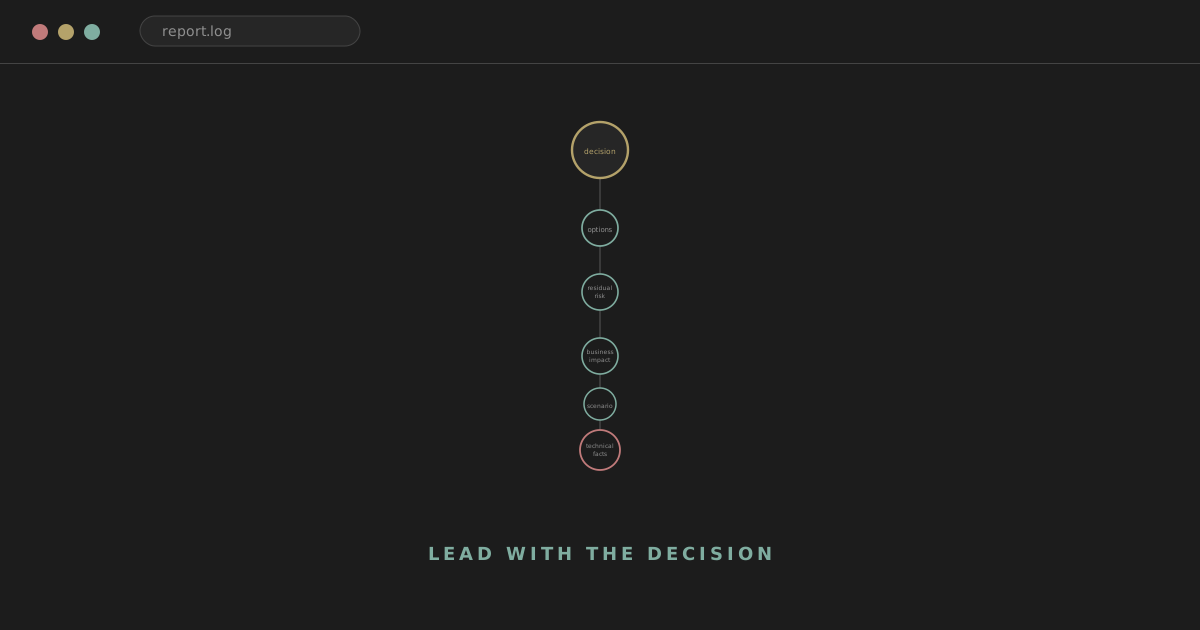
                DECISION
                   ▲
                 OPTIONS
                   ▲
              RESIDUAL RISK
                   ▲
            BUSINESS IMPACT
                   ▲
            SECURITY SCENARIO
                   ▲
             TECHNICAL FACTS
An analyst usually starts at the bottom of that pyramid, building up from the facts. An executive usually needs to start at the top. Everything at the top should still trace cleanly back to what's underneath it.
Start with the business service
"FS-02 has unsupported SMB" means nothing to most readers. "FS-02 supports payroll processing for approximately 1,200 staff" means something immediately. Asset identifiers aren't business context on their own; APP-17 says nothing, "the public patient portal" does. Keep the technical identifier for traceability, but always name what the service actually is, what customers or staff depend on it, what data sits behind it, and what breaks if it fails.
Cause, event, impact
Turn a technical condition into a scenario using a simple chain: condition, then event, then impact. Condition: the legacy admin portal doesn't enforce MFA. Event: an attacker obtains administrator credentials. Impact: the attacker can administer production systems without a second factor, potentially leading to service disruption, data access, or recovery costs. "Shared admin account" becomes "multiple support engineers use the same privileged account, which prevents reliable attribution of administrative actions and increases the impact of credential compromise," not by adding drama, just by stating the actual mechanism.
Avoid cyber-apocalypse language. "This vulnerability could allow attackers to completely compromise the entire company" is rarely actually supported by evidence. "Successful exploitation could provide code execution on the public application server; network segmentation limits direct access to database infrastructure, but customer data accessible through the application remains at risk" is precise, calm, and considerably more credible, precisely because it's bounded by what the evidence actually supports. Almost any finding can theoretically cascade into catastrophe if enough unlikely assumptions get stacked on top of each other; that's not useful risk communication. Use the credible scenario, and state the assumptions behind it explicitly.
Likelihood and impact
When asked "how likely is this," resist "73%" unless a genuinely defensible methodology actually produces that number. Explain the drivers instead: likelihood is elevated because the system is internet-facing, exploitation is public, no authentication is required, the relevant service is genuinely exposed, and no patch has been applied yet; existing WAF controls may reduce some attack paths without eliminating the risk. That's more useful than false precision dressed up as rigour.
Translate impact across the categories that actually apply, without assuming every issue touches all of them: confidentiality (what could be exposed), integrity (what could be changed), availability (what could stop working), privacy (could personal or sensitive data be affected), financial (potential business loss), operational (can staff and customers still work), safety (any physical or human consequence), and regulatory (any likely notification or compliance consequence). Security often doesn't know the actual outage cost, the contractual penalties, or the real customer impact, that's genuinely business knowledge, not security knowledge, and the right move is asking the business rather than inventing a number.
Controls and residual risk
Don't list product names, CrowdStrike, Splunk, Entra ID, unless the specific product genuinely matters to the decision. Explain outcomes instead: "administrative access is restricted to the corporate VPN, MFA is required at the VPN, the legacy application itself does not enforce individual authentication, and administrative activity is logged." That tells the reader what's actually reducing risk today, and, just as importantly, what it doesn't solve. "We have a firewall" says almost nothing; "the service is restricted to approved network sources, which reduces exposure, but shared administrator credentials still prevent individual accountability" tells the reader exactly where the remaining gap sits.
State residual risk plainly rather than implying the controls have resolved everything: "these controls reduce the likelihood of unauthorised access, but a compromised shared credential could still be used by anyone with access to the management network." That sentence is the whole point of the exercise, and it's the sentence most reports quietly skip.
Options, recommendation, decision
Reporting improves dramatically the moment it offers genuine options rather than a single problem statement. Option A, remediate now: emergency patch tonight, a two-hour planned outage, low residual risk once validated. Option B, temporary mitigation: remove public access, restrict to VPN until the scheduled patch, customers temporarily lose direct portal access, residual risk reduced. Option C, accept: leave the service unchanged until the normal patch window in ten days, residual risk elevated in the meantime. Each option needs a genuine consequence attached, cost, time, operational impact and resulting risk, not just "fix it" versus "don't fix it."
Security should usually offer a recommendation, not just a menu. "We recommend Option A because..." is what an advisor actually does; dumping three options and saying "business decision" without a view isn't advice, it's abdication. The risk owner still makes the actual call: "I understand the residual risk but require the system for month-end processing; I accept continued operation until Friday subject to these controls" is entirely legitimate governance, provided the authority and process for that acceptance genuinely exist.
Escalations specifically need to be sharp, not a document dump. Not "please see attached 47-page assessment." Instead: decision required (approve temporary shutdown of external access until the patch is applied); why (internet-facing, unauthenticated vulnerability); current exposure (public exploit available); impact (potential customer-data access and service interruption); deadline (before the service reopens tomorrow morning); technical detail attached separately, not inline.
The one-page risk summary
A reusable structure worth keeping close at hand: title (the issue, one sentence); business service (what's actually affected); current condition (what's happening); risk scenario (what could happen); business impact (why it matters); current controls (what reduces the risk today); residual risk (what remains); options (what could be done); recommendation (what security actually recommends); decision required (who needs to decide what, by when); owner and target date (who acts); evidence or appendix (where the technical detail lives). Not a universal standard, the same practical model this whole series has used throughout, applied here to the reporting layer specifically.
Worked examples
Identity. Technical: seventeen privileged accounts sit exempt from the Conditional Access MFA policy. Translated: "seventeen administrative accounts can access critical Microsoft 365 administration functions without the MFA policy applied to other privileged users. If credentials for one of these accounts are compromised, an attacker could obtain administrative access without our standard second-factor control. No current evidence indicates compromise. We recommend removing the exclusions within seven days; three legacy service dependencies may need temporary exceptions in the meantime." No scare language, no false certainty, a clear ask.
Supplier risk. MedConnect's overseas support subcontractor holds persistent privileged production access. "MedConnect's overseas support provider maintains standing privileged access to the patient portal environment. Access uses individual accounts and MFA, and activity is logged, but privilege doesn't currently expire once support work is complete. Because the service processes sensitive health information, we recommend moving to time-limited privileged access. MedConnect has committed to implementing this within 90 days. Until then, current controls reduce, but don't eliminate, the risk associated with standing third-party privilege." Precise, proportionate, and doesn't overstate what's actually known, exactly the assurance discipline from the supplier assurance and cloud assurance articles applied to a written report.
An incident, early. "One finance account was compromised through session-token theft. The attacker accessed email and SharePoint for approximately 45 minutes. The account has been contained, sessions revoked, and the device isolated. Current evidence shows access to two finance folders but no confirmed data exfiltration. Investigation is continuing; no wider compromise has been confirmed. The immediate decision required is whether to notify affected business stakeholders while the data-access review continues." Notice what it doesn't claim: not "no data was accessed," but "no confirmed exfiltration so far," a genuinely different, more honest statement.
Incident reports should change shape as the investigation matures. Early: known, unknown, and immediate actions. Mid-incident: scope, containment, and business impact. Later: root cause, remediation, and lessons learned. Don't perform certainty early that the evidence doesn't yet support.
KNOWN     → what the evidence actually supports
UNKNOWN   → what hasn't been established yet
NEXT      → what the team is doing about it
This structure alone prevents most speculative overreach in incident communication, and it's worth using deliberately rather than improvising each time.
Ten before/after rewrites
| Before | After |
|---|---|
| EDR telemetry coverage degraded by 2.3% due to sensor health state. | Five critical servers are currently not reporting to the endpoint security platform, reducing detection coverage there. Engineering expects all sensors restored today. |
| Multiple severe vulnerabilities with high CVSS base scores require remediation. | Three internet-facing systems contain vulnerabilities with public exploits available. Patches exist and are scheduled for tonight. |
| 96% critical-server EDR coverage. | Three domain controllers are not currently reporting to endpoint security following an agent-upgrade failure, reducing detection on systems that control enterprise authentication. Reinstallation is underway, expected complete today. |
| No recovery test performed in 18 months. | Backups for the order-processing platform complete successfully, but a full service restoration hasn't been demonstrated in 18 months. We have evidence backups are created, but limited assurance recovery would meet the four-hour business target. We recommend a full recovery exercise this quarter. |
| Four critical log sources offline. | Security monitoring currently lacks authentication and administrative telemetry from four systems supporting online payments. The systems remain operational; an expired logging certificate is the cause, with restoration expected today. Detection confidence for those systems is reduced until then. |
| SaaS audit logs available but not integrated. | The SaaS provider is meeting its logging responsibility; our tenant simply isn't forwarding those events to the SOC yet. This reduces our ability to identify misuse of privileged tenant accounts. Integration can be enabled within the existing licence. |
| Legacy system lacks MFA. | The payroll administration application cannot currently integrate with our central MFA platform. Access is restricted to the corporate network, requires VPN MFA for remote users, and is monitored. These controls reduce exposure but don't provide MFA at the application itself. Replacement is scheduled for March; decision required is whether to approve a temporary exception until 31 March, subject to monthly privileged-access review. |
| 5 million firewall blocks this month. | (omit, unless it supports a decision or a genuine trend, this is a vanity metric on its own) |
| Cybersecurity posture enhancement activities remain ongoing. | Identity Engineering is removing the four remaining MFA exceptions by 15 October. |
| Remediation is being progressed. | Identity Engineering will remove the three legacy exclusions by 15 October. |
Uncertainty and confidence
Good security reporting is comfortable saying what it doesn't yet know. "We have not identified evidence of data exfiltration" is a genuinely different statement from "no data was exfiltrated," and conflating the two is one of the more damaging habits in incident communication. "We cannot confirm whether..." and "based on the evidence currently available, we assess..." are honest, professional phrasings, not weaknesses. Where useful, describe confidence qualitatively, high, moderate or low, only where the methodology actually supports it, and explain why: "moderate confidence, because identity logs cover 90 days but endpoint telemetry is unavailable for the affected server." Never dress that up as an arbitrary percentage.
Some phrases simply shouldn't appear in a credible report: "we are 100% secure," "the attacker definitely didn't access anything else," "this is guaranteed to prevent recurrence," "there is zero residual risk," "the supplier is safe." Each one claims a certainty that essentially never actually exists, and saying "I don't know yet, here's what we're doing and when you'll have an update" is a professional, normal answer, not a failure to have one.
Audience tiering
| Audience | Needs |
|---|---|
| Engineer | Technical condition, evidence, configuration, remediation steps |
| Security manager | Risk, scope, owner, deadline, dependencies |
| Executive / risk owner | Business consequence, residual risk, options, decision |
| Board / governance | Material exposure, trend, strategic implication, assurance, major decisions |
Not every board wants identical reporting, and it's worth confirming what a specific board actually expects rather than assuming. In general, boards don't need alert counts; they need material cyber risks, major incidents, critical control weaknesses, resilience posture, supplier concentration, remediation trends, investment decisions, and risk-acceptance decisions genuinely worth their attention. Keep it high-level by design, not because the detail doesn't matter, because it lives one layer down where it belongs.
Materiality and escalation
Not every security finding is material to an executive audience, and escalating everything trains the audience to stop reading. Ask whether an issue could materially affect a critical service, sensitive information, a strategic objective, a major customer relationship, regulatory exposure, or a significant financial outcome; if not, it likely belongs in operational reporting rather than an executive briefing. One low-severity finding on one system is probably operational noise. The same finding recurring across forty critical systems is a different signal entirely, a systemic control weakness worth real attention. Escalate significance, not volume.
Ratings, heatmaps, scores
If the organisation uses Critical/High/Medium/Low or a 5x5 matrix, use it consistently, and never let the label stand alone: "High" by itself explains nothing, "High" with the reasoning behind it does the actual work. Heatmaps can give a useful portfolio overview, and they can just as easily hide uncertainty, buried assumptions, missing control context, clustered related risks, and the one individually material issue sitting quietly inside an otherwise green square. Never let a coloured square substitute for the narrative behind it.
RAG status can genuinely help, provided red and amber are actually defined: "red means residual risk above tolerance and immediate executive decision required," not "the security person feels concerned about it." A composite score like "72 out of 100 cyber risk" looks precise and rarely is; ask what it actually represents, how it's derived, and what decision genuinely changes between 72 and 74. Composite scores routinely hide the specific driver that actually matters. Report the underlying drivers directly instead of the number that averages them away.
Metrics and trend
A good metric tells a story rather than a bare figure. Not "98.4% MFA coverage," but "98.4% overall privileged MFA coverage, remaining gap four legacy privileged accounts, two fewer than last month, target zero, remediation scheduled by 31 October." Number, context, trend, action, together, is considerably stronger than a graph alone, and it's worth building that habit deliberately, covered in more depth in the metrics article.
Trend matters more than the raw current figure most of the time. "Twelve High findings" reads completely differently depending on whether last quarter had thirty (genuinely improving) or two (quietly getting worse), and hiding deterioration behind a percentage that happens to look stable is a real failure mode worth watching for in your own reporting. Report control health in terms an executive actually cares about, identity risk, vulnerability exposure, detection coverage, recovery confidence, supplier residual risk, material incidents, rather than raw tool statistics like "five million firewall blocks" or "two million malicious emails stopped," which are vanity metrics unless they genuinely support a specific decision or trend.
The same discipline applies to assurance and supplier reporting specifically. "92% of critical systems have completed assurance reviews" can be genuinely misleading if the remaining 8% happen to be the highest-risk ones; report coverage, the important gaps, the actual findings, and the trend together. "97% of vendors assessed" tells you little; "all 28 critical suppliers have current assurance except two awaiting reassessment, one carrying a High residual privileged-access risk with remediation due next month" tells you what actually needs attention. The same goes for exceptions: not "73 exceptions," but "73 active, 6 High residual risk, 4 expired, 18 relating to legacy MFA, with a replacement programme already scheduled," which actually informs governance rather than just reporting a count.
Executives generally don't need an 80-row risk register; surface material risks, what's changed, what needs deciding, what's overdue, and any emerging trend, keeping the full register available underneath for anyone who needs it. A "top 5 risks" format can work well, provided it actually moves over time; an unchanged top five for months quietly becomes wallpaper nobody reads. Report movement, treatment progress, new evidence, and decisions still needed, not just the same five labels recurring unchanged.
Writing style
Short sentences, active voice, specific nouns, clear verbs. "Cybersecurity posture enhancement activities remain ongoing" says nothing; "Engineering is removing the four remaining MFA exceptions" says exactly what's happening and who's doing it. Passive language quietly hides ownership: "remediation is being progressed" versus "Identity Engineering will remove the three legacy exclusions by 15 October," the second version is the only one anyone can actually hold accountable. Use concrete dates rather than "soon" or "shortly"; a treatment without an owner, an action and a date isn't really a plan, it's a hope with a status label attached.
When something's overdue, say why. "Remediation is 21 days overdue because the vendor release was delayed; existing network restrictions remain in place; risk owner review is required if replacement slips beyond 30 October" is useful, actionable governance. Be factual rather than soft to the point of meaninglessness: "an opportunity exists to enhance authentication" hides the actual fact, "four privileged accounts do not use MFA" states it. Calm doesn't mean vague. If a control genuinely failed, say so directly, explain the consequence, the root cause and the corrective action, trust depends on that accuracy, and equally, don't overstate a single isolated exception into "the identity process failed completely" when it didn't.
Root cause and aggregation
For anything recurring or systemic, name the actual root cause rather than reporting each instance as its own isolated ticket. "17 servers missing EDR" reported individually is 17 tickets; "a new cloud deployment pipeline doesn't include EDR installation" is one systemic fix that prevents the next 17. Hold isolated and systemic apart deliberately, one misconfigured host is an isolated finding, a deployment process that repeatedly produces the same misconfiguration is systemic, and systemic issues generally warrant considerably more executive attention than their individual severity ratings would suggest on their own.
Several individually small findings, expired accounts, weak access review, shared admin accounts, MFA exceptions, can point toward one larger underlying theme, here, a genuine privileged-identity-governance weakness, worth naming as the theme it actually is rather than reporting each symptom separately and letting the pattern go unnoticed.
Decision log and acceptance
For material risks, maintain a decision log: the issue, the options presented, the recommendation made, the actual decision, who made it, the date, any conditions attached, and a review date. This gives real governance traceability, and it's what turns "we discussed this once" into something you can actually point back to later.
Risk acceptance specifically deserves more than a bare "accepted" label: record who accepted it, why, what controls remain in place, for how long, when it gets reviewed, and what would trigger an earlier reassessment. Temporary acceptances especially need visible expiry, "accepted until March" should actually surface again as March approaches, tied into exception metrics rather than quietly forgotten.
Where security and the business genuinely disagree on severity, don't just report the disagreement flatly, "business refused to accept security's rating" helps nobody. Document the actual assumptions behind each view: "security assessed impact as High based on a potential two-day service outage; operations assesses it as Moderate because manual processing can sustain essential activity for five days; a resilience exercise is scheduled to validate the manual fallback assumption." That's mature, testable disagreement, not a standoff.
Every risk assessment rests on assumptions, the WAF blocks the known exploit path, recovery completes within four hours, supplier notification actually works, segmentation prevents lateral movement, and important ones deserve to be stated visibly rather than left implicit. Where a rating depends on an assumption like "backups will restore," test the restore; where it depends on "segmentation prevents access," validate that segmentation, tying reporting directly back into the assurance work covered throughout this series. It also helps to separate what's actually known from what's assumed from what remains genuinely unknown: known, MFA is excluded on three accounts; assumed, those accounts are only ever used from the corporate network; unknown, whether direct access exists from the supplier's VPN. That three-way split is often more useful to a risk owner than any single confidence label could be.
The 30-second version
Practise compressing an issue into roughly thirty seconds: "three legacy administrator accounts can access production without MFA. Network restrictions and monitoring reduce exposure, but compromised credentials could still provide privileged access. Migration is scheduled in six weeks. I need approval for the temporary exception until then." That's genuinely executive-ready as it stands. A two-minute version adds the system and business service, the supporting evidence, the controls, the treatment, and the timing, while still stopping well short of a full investigation dump. The technical appendix behind either version carries account IDs, architecture detail, evidence, vulnerability specifics, logs, and the remediation task list, layered communication, not one document trying to serve every audience at once.
Executive questions to expect
How bad is it? Has this happened before? Are we compromised right now? What's the worst credible outcome? What are we doing about it? How long will it take? How much will it cost? What happens if we do nothing? Who owns this? Are customers affected? Are we legally required to do anything? Why wasn't this identified earlier? Answer what you genuinely know, and say so plainly when you don't yet: "was data stolen" answered with a flat "no" while the investigation is still running is a bad answer even if it later turns out to be true; "we have not identified evidence of data exfiltration so far, log review is still in progress, we expect a firmer assessment by 3pm" is the honest, professional version. Know when a question genuinely needs legal, privacy, communications or business-continuity involvement rather than a security-only answer, and say that directly rather than improvising a legal conclusion security isn't actually positioned to give.
A monthly report structure
An illustrative structure, not a mandatory template: material incidents; top cyber risks; significant changes since the last report; critical control health; material supplier risk; overdue remediation; exceptions requiring attention; key trends; decisions required. Kept genuinely concise. What generally doesn't belong here: huge vulnerability tables, IOC counts, raw SIEM alert volumes, product uptime unless it's actually relevant to a decision, every individual pen-test finding, every low-risk supplier issue, and massive control matrices, all of which stay accessible in the layers underneath rather than cluttering the top one.
Practical exercises
Exercise 1. Take a raw CVE description, CVSS score, affected system, exploit availability, and rewrite it for an executive using the technical-fact-to-decision chain.
Exercise 2. "The Conditional Access exclusion group contains 12 privileged accounts." What does the decision-maker actually need to know beyond that one sentence?
Exercise 3. A supplier holds a strong SOC 2 report with one unresolved privileged-access exception. Translate that into risk, control, treatment and decision.
Exercise 4. A SIEM source has been offline for 21 days. What's the actual business and security consequence, stated plainly?
Exercise 5. 99.9% backup success, no restore test in 18 months. Translate it using the before/after pattern from earlier in this article.
Exercise 6. Given raw technical incident notes, produce known, unknown, next, business impact, and the decision required.
Exercise 7. A legacy system has no MFA, genuine compensating controls are in place, and replacement is four months out. Write the risk-acceptance summary a risk owner could actually sign off on.
Interview questions
"How would you explain a technical vulnerability to an executive?" Name the business service, describe a credible scenario, explain the consequence, state current controls and what remains, offer options, and make a recommendation. "What's the difference between a finding and a risk?" A finding is a fact; a risk is what that fact could actually lead to, stated as a scenario with a consequence attached. "What should an executive risk report contain?" Decision-quality information: business impact, controls, residual risk, options, a recommendation, and the specific decision required, not a technical investigation dump. "How do you avoid fearmongering?" Use credible scenarios backed by actual evidence, state your assumptions, and never reach for the maximum imaginable outcome when a bounded, realistic one is what the evidence actually supports. "What if the business won't accept your risk rating?" Document both parties' assumptions clearly rather than treating it as a standoff; test the assumptions where possible rather than simply asserting a rating. "How do you communicate uncertainty?" Directly: state what's known, what's assumed, and what remains genuinely unknown, and say "I don't know yet" when that's the honest answer. "What would you include in a board cyber update?" Material risks, major incidents, critical control weaknesses, resilience, supplier concentration, trends, and the investment or acceptance decisions genuinely in front of them. "How would you justify security investment?" Frame it around risk reduction and the actual decision needed, not the tool itself; "we need a PAM tool" becomes "32 privileged accounts currently retain standing access, manual reviews only catch problems after the fact, and a PAM capability would enable time-limited elevation, approval and individual logging." "How do you report an incident before the scope is fully known?" Known, unknown, next, updated honestly as facts change, without performing certainty the evidence doesn't yet support. "Who should accept residual risk?" An authorised risk or business owner, never the analyst who identified it, the same principle running through this entire series.
A model answer for "how do you communicate security risk to senior stakeholders": start with the affected business service; explain a credible risk scenario; describe the business consequence; explain current controls; state the residual risk and any genuine uncertainty; present practical treatment options; make a security recommendation; identify the decision required and its owner; keep the technical evidence available underneath; and update the report as facts actually change.
Ten reporting principles
Lead with the decision. Name the business service. Describe a credible scenario. Explain the impact. Explain the controls, and their limits. State what actually remains. Show genuine options. Make a recommendation. Be explicit about uncertainty. Keep the evidence available underneath. Worth pinning somewhere visible; most of the article above is really just these ten ideas, worked through in detail.
Common mistakes
"Executives aren't technical." An overgeneralisation that misreads the actual gap. "Remove all technical detail." No, layer it instead. "More slides mean better reporting." No, usually the opposite. "High risk speaks for itself." No, a label without reasoning explains nothing. "Red means everyone understands the urgency." Not necessarily, without a defined meaning behind it. "CVSS 10 means Critical business risk." No, technical severity and business risk are different questions. "The risk score is objective." Not necessarily, definitions and weighting are judgement calls dressed up as arithmetic. "If no decision is required, put it on the executive agenda anyway." Usually unnecessary, and it trains the audience to stop paying attention. "Security should only present facts, never recommendations." No, a good advisor recommends. "Security decides business risk." Usually no, that authority sits with an authorised business or risk owner. "Uncertainty makes us look weak." No, false certainty is what actually erodes trust once it's proven wrong. "Executive reports should show every security metric." No, surface what's material and keep the rest one layer down.
The point
Go back to APP-07. "CVSS 9.8, unauthenticated RCE, public PoC" is accurate, and it's not yet useful to the person who has to decide what happens tonight. The service it affects, the credible scenario, what it could actually cost the business, what's already reducing the risk, what's left once those controls are accounted for, the real options, a clear recommendation, and the specific decision needed by a specific time, that's the same fact, turned into something someone can actually act on.
None of this is about making cybersecurity simpler than it is. It's about making sure the person with the authority to decide actually has what they need to decide well, and trusting them with the truth, uncertainty included, rather than a comforting summary that quietly leaves out the part that mattered.